If you are working out how to build a dog park for your estate or municipality, the equipment is the easy part. The decisions that make or break a shared off-leash area are the site, the fencing and gates, separate zones for small and large dogs, the surface, water and shade, and clear rules.

This guide takes you through each step in the order you will meet it, with South African conditions in mind: summer storms, dry winter dust, ticks, heat and water restrictions. It also covers the approval and governance questions that body corporates, HOAs and parks departments need to settle before anyone digs a hole.
The best advice is to start small, do the essentials well and add features in phases once you see how residents actually use the space.
How to build a dog park: start with people and approvals
Most shared dog park problems come from people, not equipment. Hold a meeting early and invite dog owners, residents without dogs and anyone whose home borders the proposed site. Their concerns about noise, smell, parking and safety will shape the design.
Estates, HOAs and body corporates
- Trustee or board approval: get the project formally approved and minuted before you commit to a site or design.
- Conduct rules: check what your existing rules say about pets, then decide whether they need updating to cover the dog park. Changing conduct rules usually needs owner approval, so ask your managing agent about the process.
- Funding: decide whether it comes from the levy budget, a special levy or resident fundraising, and who pays for upkeep afterwards.
- Liability: speak to your insurance broker about public liability cover and whether indemnity signage is advisable.
- Upkeep: name who inspects the fence, empties bins and maintains the surface, and give it a budget line.
Municipal parks
Public open space is governed by municipal by-laws on dogs, leashing and park use, so start with your parks department and ward councillor. Ask whether the site needs a council resolution, a permit or a public participation process.
A friends-of-the-park group can help raise funds, report damage and keep an eye on behaviour. Plan for security from the start: clear sightlines, lighting if the park opens after dark, and fencing and fittings that are hard to steal.
Choosing the right site
There is no single correct size for a dog park. It must be big enough for dogs to run without crowding at the gate, and ideally big enough to close off a worn section while the rest stays open. A long or irregular shape encourages running along a loop, while a small square tends to concentrate dogs at the entrance.
Walk the site after a summer storm and again in the dry winter months if you can. Use this checklist before you commit.
- It drains well and has no low point where stormwater pools.
- It is well away from children’s playgrounds and any school or creche play area, with separate entrances and paths.
- It is not right against homes, because barking carries.
- The entrance is reachable from parking or a walking route, but set back from busy roads and through traffic.
- There are existing trees nearby, or room to plant them outside the fence line.
- A water connection is close, or there is space for a tank.
- Power is available if you need lights or a borehole pump.
- Security staff or patrols can see into the park.
Fencing and double-gated entry
The right fence height depends on the dogs that will use it, because athletic and large breeds clear an ordinary garden fence easily. Ask your fencing contractor to recommend a height in metres for your site and check any estate architectural guidelines or municipal rules on fence heights.
- Stop digging: set the fence below ground or along a concrete strip so dogs cannot tunnel out.
- Small gaps: ask the contractor to choose a mesh or slat spacing that the smallest expected dog cannot squeeze through or get its head stuck in.
- Visual screening: shade cloth or planting on sections of the fence reduces fence running and barking at passers-by.
- Maintenance gate: a separate, lockable gate wide enough for a mower or bakkie keeps service traffic away from the dog entrances.
Why the double gate matters
A double-gated entry (also called an airlock or sally port) is two self-closing gates with a holding space between them. Owners step in, close the outer gate, unleash and only then open the inner gate, so no dog escapes and arriving dogs are not mobbed at the opening.
Make the holding space roomy enough for someone with two dogs, a pram or a wheelchair. Fit latches at a height a wheelchair user can reach, and ask your architect whether SANS 10400-S accessibility requirements apply to your paths, parking and gates. Each zone should have its own double-gated entry.
Dog park design: separate zones for small and large dogs
Good dog park design separates dogs by size and play style. A small-dog paddock protects little dogs from being bowled over, and it also suits senior dogs, shy dogs and dogs recovering from injury.
Avoid a strict weight cut-off. Signage that asks owners to choose the area that suits their dog’s size and temperament works better and is easier to manage.
Put a visual barrier, such as shade cloth or a hedge, between the two areas so dogs do not run the dividing fence all day. A typical layout includes the following zones.
- Entry area: the double gate, a waste station and a notice board.
- Large-dog run: the longest open space, with a loop path along the fence.
- Small-dog paddock: a calmer area with its own entry, shade and water.
- Owner area: shaded seating with a clear view of both zones.
- Rest section: a part that can be closed off while the grass recovers.
- Agility corner: optional obstacles, placed away from the gates so they do not cause bottlenecks.
If you plan to add obstacles, our dog agility equipment guide for dog parks covers how to choose and lay them out. For a shared park, ask suppliers how each item is finished for outdoor weather and how it is anchored.
Surfaces, drainage and the South African climate
No single surface suits a whole dog park. Most parks combine a softer main area with harder-wearing surfaces where traffic concentrates: at the gates, along the fence and around water points.
| Surface | Works well for | Watch out for |
|---|---|---|
| Natural grass | Main play areas; cool and pleasant | Bare patches at gates and fence lines, summer mud, winter dust, irrigation needs |
| Wood chips or bark | Under trees and high-traffic patches | Can wash away in storms, waste is harder to spot, needs topping up |
| Gravel or crushed stone | Paths, entry areas, drainage strips | Gets hot in sun, some dogs dislike it, stones get scattered |
| Artificial grass | Small-dog paddock, entry areas | Heats up in direct sun, needs drainage below and regular rinsing |
| Paving or concrete | Paths, around water points | Hot in summer, hard underfoot, best kept to paths |
Plan for summer storms and dry winters
Highveld and inland thunderstorms turn a flat, compacted dog park into mud within minutes. Grade the ground so water runs off, add drainage where it collects, and make sure runoff does not flow onto neighbours or paths.
In dry winter regions, grass goes dormant and worn areas become dusty. Put durable surfaces where dogs gather, keep a loop path along the fence where they naturally run, and rotate a rest section so worn grass can recover in the growing season.
Water, shade, heat and ticks
Water supply that survives restrictions and load-shedding
Drinking water is essential, especially in summer. A dog-height drinking fountain with a drain beneath it is easier to keep clean than communal bowls, which collect algae and mosquitoes.
- Municipal connection: simplest option, but check whether water restrictions limit irrigation or hosing down.
- Rainwater tank: useful for cleaning and irrigation, and as a backup during restrictions.
- Borehole: check national and municipal registration requirements, and test the water before dogs drink it.
- Load-shedding: an electric borehole pump stops when the power does, so plan a storage tank, gravity feed or backup power.
Shade and heat
Trees planted just outside the fence can grow over the play space without being dug up or damaged by urine. Until they mature, use shade sails or a shade structure over seating, the water point and the small-dog paddock.
Post a sign reminding owners that hot surfaces burn paws and that midday exercise in summer is risky. Consider early opening hours so dogs can play in the cooler morning. UV is strong for much of the year, so shade over seating protects owners, and light-coloured or thin-coated dogs can sunburn on exposed skin such as noses and ears.
Ticks
Ticks thrive in long grass and untidy edges, and they can carry biliary in dogs and tick-bite fever in people. Keep grass short, clear the fence line and make up-to-date tick and flea control an entry rule.
Rules, management and phasing
Clear rules, posted at every entrance, prevent most problems. Keep them short enough to read while holding a lead.
- Health: dogs must be vaccinated, including against rabies, which is compulsory in South Africa, and be on current tick and flea control. No dogs in season, unwell dogs or dogs with a history of aggression.
- Behaviour: keep dogs on a lead when entering and leaving, and unclip only inside the entry area. No food or treats in the play areas, and leave immediately if your dog becomes aggressive.
- Owners: stay in the park, keep your dog in sight and under voice control, and pick up after it using the waste stations. Supervise children, and keep to the limit on how many dogs one person may bring.
- Notices: display opening hours, an emergency contact and the nearest vet.
Estates can go further by asking residents to register dogs and submit proof of vaccination before using the park. Agree a simple process for complaints so trustees are not left to referee disputes.
Amenities and upkeep
Place waste stations with bags and bins at each entry and along the loop path, and empty them often. Add shaded seating, nearby parking and a tap for cleaning. A weekly walk of the fence line to check for holes, broken latches and gates that do not close properly catches most problems early.
Start small, then build in phases
- Phase one: fencing, double-gated entries, separate small and large dog areas, water, waste stations and basic shade.
- Phase two: seating, extra shade, surface upgrades at worn spots and a few agility obstacles.
- Phase three: lighting, more obstacles and planting, based on how residents use the park.
Questions to ask your supplier
- Is installation included, and what site preparation must we do first?
- What are the dimensions of each item, and which dog sizes is it recommended for?
- How is each item finished for outdoor weather, and how is it anchored?
- What maintenance should we plan for as owners?
- Can you give an itemised quote that separates equipment, delivery, installation and any surfacing?
Costs are driven mainly by the size of the park, the length and type of fencing, the number of gates, surfacing, water supply, site preparation and installation. An itemised quote lets trustees or council officials compare options line by line.
How GreenAir can help
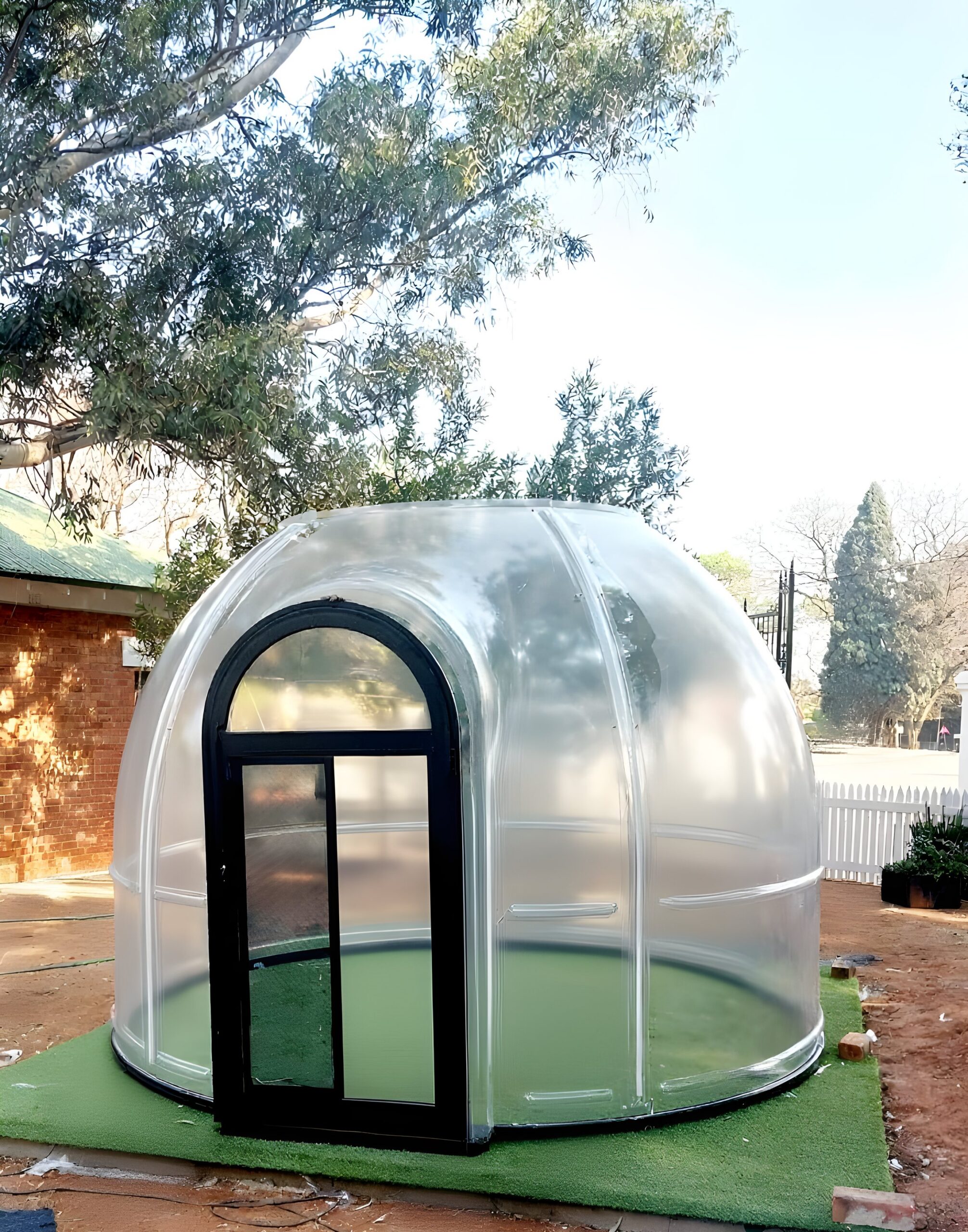
GreenAir is based in Johannesburg and supplies dog park equipment to residential estates, body corporates, municipalities and parks, as well as playground safety flooring, including artificial grass, and outdoor domes.
Products such as the Dog Park Teeter Tottter, Dog Hoop Jump and Dog Steppers are examples to look at. Ask us for the dimensions and recommended dog sizes before you choose.
If you are planning a larger space, our design-and-build support for park projects can help you bring the layout together. We install anywhere in South Africa, including Johannesburg, Pretoria, Cape Town, Durban and regional areas.
For Zimbabwe, Botswana, Zambia, Namibia and Tanzania, we supply and deliver the equipment only, and installation is not included. We work on quotes rather than published prices, and our quotes are free and itemised.
Frequently asked questions
How big does a dog park need to be?
There is no single correct size. It depends on how many dogs you expect at busy times, whether you include a separate small-dog paddock and whether you want a rest section for the grass to recover. A long or irregular shape works better than a small square. Walk the site at peak times, and build only what you can maintain well, adding space in later phases.
How high should a dog park fence be?
It depends on the dogs that will use it. Large, athletic breeds and climbers need a noticeably taller fence than an ordinary garden boundary, while a small-dog paddock can be lower but needs tight gaps. Ask your fencing contractor to recommend a height in metres, set the base below ground to stop digging, and check estate guidelines or municipal rules on fence heights.
Who pays for an estate or municipal dog park?
In estates, trustees usually approve funding from the levy budget, a special levy or resident fundraising, depending on the scheme’s rules. In municipalities, it may come from the parks budget, ward allocations or a friends-of-the-park group. Whoever pays to build it, agree in writing who pays for ongoing upkeep such as bins, surfaces, fencing repairs and water.
How do you keep grass alive in a dog park?
Rotate use by closing a rest section while worn areas recover, and put durable surfaces such as gravel or paving at gates, water points and along the fence. Rinse urine spots when you can, irrigate early in the morning within any water restrictions, and overseed or top dress during the growing season. On the Highveld, expect dormant grass and some dust in winter.
Planning a dog park or outdoor space? Send us your site details and we will prepare a free, itemised quote.