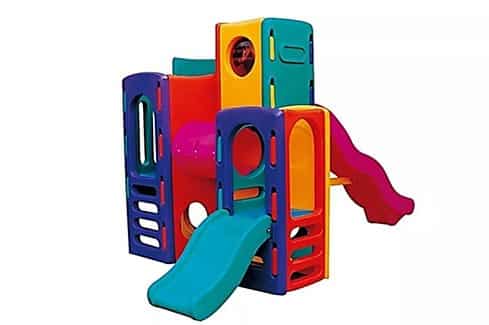
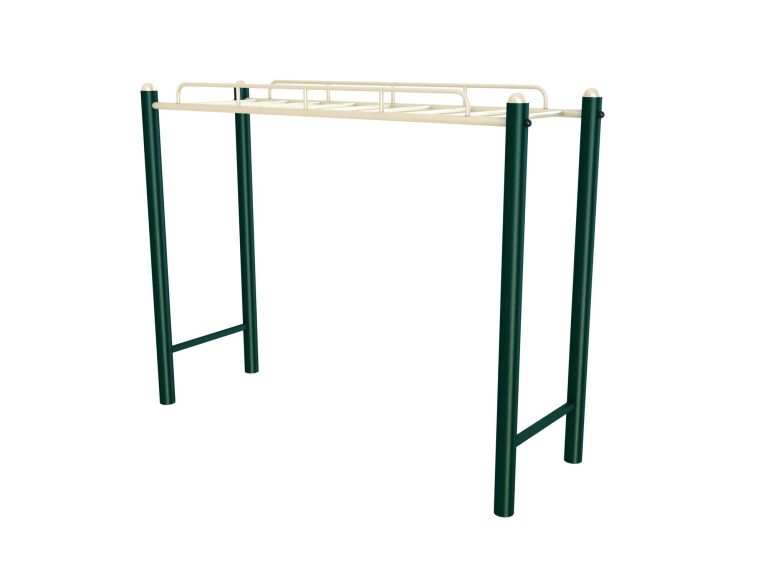
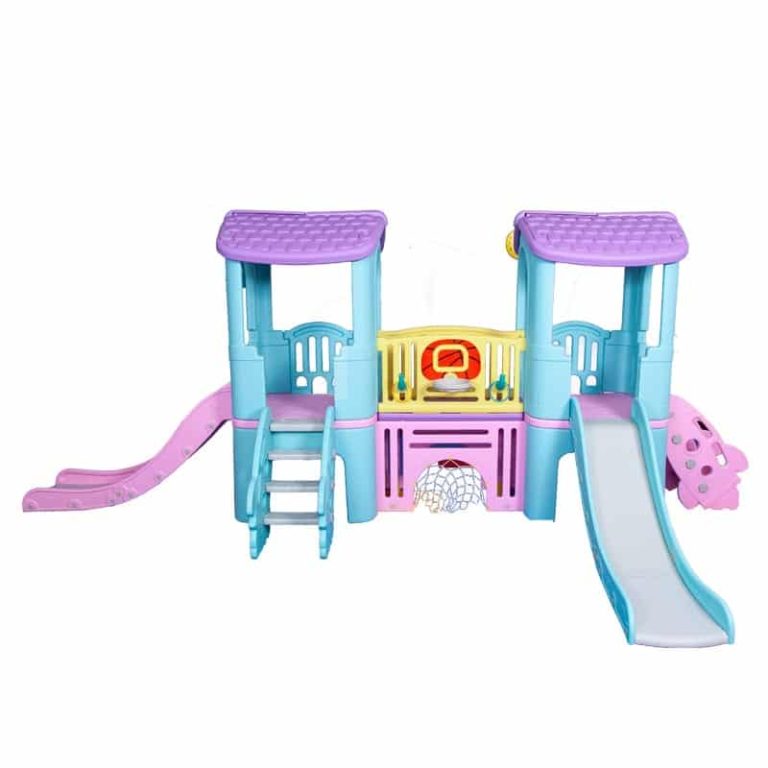
Critical fall height is the highest fall that a playground surface can cushion to an acceptable level when it is tested to SANS 51177. If the critical fall height of your surfacing is lower than the free fall height of the equipment above it, a child falling from the top is not protected the way the test intended.

Matching the two numbers is one of the most important decisions in a school, creche or park playground. It is also one of the easiest to get wrong, because surfacing is often chosen on looks, feel underfoot or budget.
This guide explains both terms in plain language, shows how impact attenuating surfacing is tested, and gives you the questions to ask before you sign off a quote.
Free fall height: the number your equipment sets
Free fall height is the greatest vertical distance a child could fall from a piece of equipment to the surface below. It is measured from the highest point where a child is clearly meant to stand, sit or hold on, not from the top of a roof or a decorative panel.
Where that point sits depends on the type of equipment:
- Platforms and decks: measured from the standing surface of the platform.
- Climbing nets, walls and ladders: measured from the highest foot support, or from a point below the highest hand support, as the equipment standard defines. Ask your supplier to state the figure.
- Swings: measured from the seat at the maximum swing angle the equipment standard defines. Ask your supplier for the figure.
- Slides: measured from the start section or the platform that leads to it.
- Spring riders and rockers: measured from the seat or footrest.
A combination unit can have several different free fall heights. For surfacing, what counts is the highest free fall height that lands in each part of the ground. Ask your equipment supplier to state the free fall height of every piece in writing.
Critical fall height: the number your surfacing must reach
Critical fall height belongs to the surface, not the equipment. It describes one specific product laid in one specific way: a set thickness, a set underlay or shockpad (if there is one) and a set base.
Change any of those and the number can change. A thinner layer laid to save money is, in effect, a different surface from the one that was tested.
| Term | What it describes | What sets it | Where to find it |
|---|---|---|---|
| Free fall height | The highest possible fall from the equipment | The equipment design | The equipment supplier’s documentation |
| Critical fall height | The highest fall the surface cushions within the test limit | The surface material and build-up | A SANS 51177 or EN 1177 test report |
| Impact area | The ground around the equipment where a child could land | The equipment design and how it moves | The equipment installation plan |
The basic rule is simple: the critical fall height of the surfacing must be equal to or greater than the free fall height of the equipment, across the whole impact area. Covering only the ground directly under the equipment is not enough.
How impact attenuating surfacing is tested to SANS 51177
SANS 51177 is the South African standard for impact attenuating playground surfacing, and it is aligned with the European standard EN 1177. It sets out how to test a surface. It does not tell you which product to buy.
In the test, an instrumented headform is dropped onto the surface from a series of heights. Sensors record how sharply it slows down, and a Head Injury Criterion (HIC) value is calculated for each drop.
The higher the drop, the higher the HIC. The critical fall height is the highest drop at which the result stays within the limit the standard allows.
Laboratory tests and site tests
Testing is often done in a laboratory on prepared samples. The standard also describes testing a surface after it has been installed, which shows whether the surface as laid behaves like the sample did.
A laboratory report tells you what a product can achieve. It does not prove that your installation was built to the same thickness, on the same base, with the same underlay.
What to look for in a test report
- The standard named on the report (SANS 51177 or EN 1177).
- The exact product and build-up tested, including thickness and any underlay.
- The critical fall height result for that build-up.
- Whether the test was done in a laboratory or on an installed surface.
- Who carried out the test and when.
- The test conditions recorded, such as temperature.
Matching surfacing to playground fall height, step by step
- List every piece of equipment and its free fall height, as stated by the equipment supplier.
- Mark the impact areas on a site plan. Where impact areas overlap, use the higher free fall height for that ground.
- Confirm which areas need impact attenuation. SANS 51176 and EN 1176 define the free fall height above which impact attenuating surfacing is required, and which surfaces are permitted below it. Ask your supplier for that table and check each item against it.
- Shortlist surfaces and request test reports for each one.
- Compare the numbers. The critical fall height must meet or exceed the free fall height. Where you can, choose a build-up with some headroom, because surfaces wear and compact over time.
- Check the quote against the report. The thickness and underlay in the quote should match the build-up that was tested.
- Plan the base and drainage. Standing water and a poorly prepared base undermine any surface.
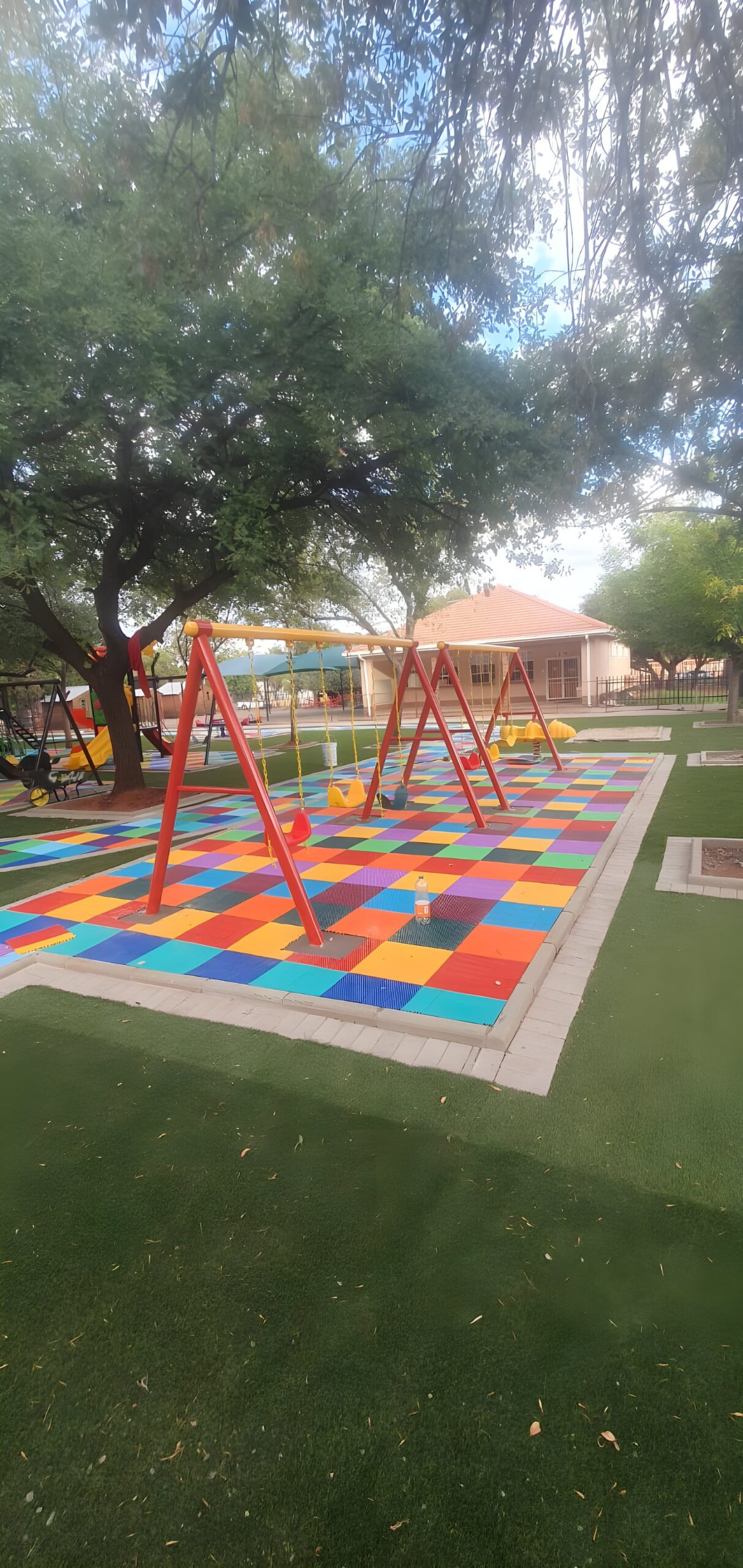
When you look through a playground safety flooring range, treat each product as a candidate to check, not as automatically right for every height. Rubber Wet Pour, Rubber Flooring, Artificial Grass For Playgrounds and Interlocking Plastic Floor Tiles are all worth looking at, but confirm with the supplier whether each has been impact tested and how it should be laid for your equipment.
If a poured surface appeals, our page on Rubber Wet Pour and our guide to wet pour flooring are starting points. Ask whether an underlay is part of the system and whether that build-up has been impact tested.
What changes critical fall height on a real site
Two playgrounds with the same product can perform very differently. These are the factors to watch:
- Thickness: a thinner layer generally cushions less. Never accept a thinner build-up than the one in the test report. Ask first what the change does to the result.
- Underlay or shockpad: some systems rely on a cushioning layer underneath. Ask whether one is part of the system and whether it is in the quote.
- Base preparation: an uneven or poorly compacted base can cause uneven wear. It can also create hard spots.
- Wear and compaction: the ground under swings and at slide exits wears first.
- Loose fill movement: sand and bark get kicked out of place. The depth that was tested is not always the depth that is there.
- Temperature: some materials behave differently in heat or cold. That is why test conditions matter.
Concrete, paving and compacted earth are not impact attenuating surfaces. Lawn that has worn down to bare ground behaves more like hard soil than grass.
Keeping the surface in the condition it was tested in is an ongoing job for the owner. Our outdoor playground maintenance and safety care guide covers what to look at and how often.
Questions to ask your supplier about critical fall height
Use this list for both the equipment and the surfacing, and ask for answers in writing:
- What is the free fall height of each piece of equipment?
- How large is the impact area around each piece, and can you mark it on our site plan?
- May we see any test reports for the equipment? If they exist, which standard does each report refer to (for example SANS 51176 or EN 1176)?
- May we see any impact test report for this surfacing? If one exists, which standard does it refer to (for example SANS 51177 or EN 1177)?
- Does the report cover the exact thickness and build-up in our quote?
- Is an underlay part of this system, and if so, is it included in the quote?
- Was the testing done in a laboratory, on an installed surface, or both?
- Can the installed surface be site tested, and who would arrange that?
- What base preparation does the surface need, and is it included in the quote?
- What care routine keeps the surface performing as it did in testing?
How GreenAir can help
GreenAir is a Johannesburg based supplier of playground safety flooring, including rubber wet pour, rubber tiles and artificial grass. We also supply outdoor play equipment such as plastic jungle gyms, toddler play equipment, slides, swings, rockers and spring riders.
We work on free, itemised quotes and do not publish prices. An itemised quote lets you see surfacing, site preparation and installation as separate lines, so you can compare like with like.
We install anywhere in South Africa, including Johannesburg, Pretoria, Cape Town, Durban and regional areas. For Zimbabwe, Botswana, Zambia, Namibia and Tanzania we supply and deliver the equipment only, and installation is not included.
We work with schools, creches and daycares, municipalities and parks, residential estates, hotels and lodges, and offer design-and-build support for park and playground projects. When you request a quote, include your equipment list and a rough site plan so the surfacing can be planned around the impact areas.
Frequently asked questions
Is critical fall height the same as the height of the jungle gym?
No. The overall height of a jungle gym includes roofs and panels that children are not meant to stand on. Free fall height is measured from the highest point a child is meant to stand, sit or hold. Critical fall height is a property of the surface below, found through SANS 51177 or EN 1177 testing. Your surface’s critical fall height must meet or exceed the equipment’s free fall height.
Do we need impact attenuating surfacing under low equipment?
SANS 51176 and EN 1176 define the free fall height above which impact attenuating surfacing is required, and which surfaces are permitted below it. Ask your supplier for that table and check each item against it. Even for low pieces, many schools and creches choose a softer surface for everyday tumbles. The impact area around moving equipment, such as swings, can extend well beyond the frame.
Can artificial grass be used under playground equipment?
It can be an option, but only if the specific system has been impact tested and the result suits your equipment. Artificial grass on its own and artificial grass laid over a cushioning underlay are different build-ups. Ask whether an underlay is part of the system and whether that build-up has been impact tested, then request the report and check which standard it refers to.
What drives the cost of surfacing for higher fall heights?
The main cost drivers are the total area you need to cover, the thickness of the surface, whether an underlay is needed, how much base preparation the site needs, drainage, and installation. Higher equipment usually means larger impact areas and a deeper build-up. A free, itemised quote shows each of these as a separate line so you can see where the money goes.
How often should we check our playground surfacing?
Look at high wear spots, such as under swings and at slide exits, frequently, because they deteriorate first. Check for thinning, cracks, lifted edges, gaps between tiles, standing water and displaced loose fill. Keep a simple written log with dates and photos. If the surface no longer matches the build-up that was tested, plan repairs before the area is used again.
Need safety surfacing? Send us your site details and we will prepare a free, itemised quote.